Unit 3 Objectives
By the end of this module participants will be able
to:
- Discuss the clinical manifestations of diabetes with peculiarities of Type 1 and Type 2 DM
- Describe the initial approach in the work up of a newly diagnose diabetic patient.
- Explain the different complications of diabetes.
- Discuss acute complications of DM and their management.
Case 1.
- A 24 yrs male patient presented with history of polyuria, polydypsia of 2 weeks duration, he gives history of weight loss of 3 kgs. On arrival the doctor in the medical OPD evaluated him and ordered an urgent Blood sugar and Urine analysis. The result appeared after 30 minutes showed Random blood sugar of 287 mg/dl and Urine sugar of 2 +, no ketonuria.
- Question 1.
- What is the diagnosis of the patient?
- What additional information do you like to know?
- What additional tests do you want to do?
Case 1 Ans.
- Type 1 diabetes mellitus
- Detailed history and physical exam
- Baseline Lab tests
Case 2.
A 47 yrs old male patient presented with history of profound
weakness, fatigue, weight loss of 2 months duration. He developed cough, running nose, sneezing and headache of 2 days duration for this he visited a private clinic in early morning.
His physical examination was non revealing except he had runny nose and nasal congestion.
The lab result revealed, normal CBC, FBS 178 mg/dl.Questions
- What is the diagnosis of this patient?
- How do you confirm the diagnosis?
- What additional information do you want to know?
Case 2. Ans.
- Type 2 diabetes mellitus with URTI
- Repeat FBS, HbA1c, RBS.
- Additional history, physical exam and Baseline lab tests
Clinical Manifestations of Diabetes Mellitus
- Most Type 1 diabetes mellitus and few type 2 diabetic patients usually present with
– Increased thirst and Polydypsia
– Polyuria and nocturia
– Polyphagia
– Unexplained weight loss and
– muscle wasting
– Extreme fatigue

Clinical Manifestations of DM…
- About half of type 2 diabetes patients may remain asymptomatic or might have non -specific symptoms
- More than 50% of type two diabetic patients are undiagnosed.
- Some type 2 DM patients can present with chronic complications of diabetes mellitus.
Clinical Manifestations of DM…
Other features of DM are:
- Blurred vision,
- Recurrent skin infections,
- Recurrent itching of the vulva,
- Abnormal sensory/ motor neurologic findings on extremities,
- Foot abnormalities (various deformities, ulcers, and ischemia) could be presenting signs.
- Symptoms and Signs of Acute complications
Complications of Diabetes
Diabetes or its treatment can cause acute
complications or long term complications
a) Acute
b) Chronic
a) Acute Complications of DM
- Diabetic Ketoacidosis (DKA)
- Hyperglycemic Hyperosmolar State (HHS)
- Hypoglycemia – Complication Of Treatment

Initial Evaluation of DM
- Aims of initial evaluation
– Classify the diabetes
–Detect the presence of diabetes
complications
–Review previous treatment and glycemic
control in patients with established diabetes
–Assist in formulating a management plan
– Provide basis for continuing care
Comprehensive diabetes evaluation
- MEDICAL HISTORY
– Age and characteristic of onset of diabetes (e.g. DKA, asymptomatic lab finding)
– Eating (dietary) patterns, physical activity habits, nutritional status, and weight history; in children and adolescents Growth & Development)
– History of associated conditions like hypertension
– History of diabetes related complications - Acute: DKA, Hypoglycemia, HHS
- Chronic:
– Macro vascular: CHD, CVD,PAD
– Micro vascular: retinopathy, Nephropathy, neuropathy (sensory, including history of foot lesions, autonomic, including sexual dysfunction and gastro-paresis)
– Other: Psychosocial problems, dental disease
PHYSICAL EXAMINATION
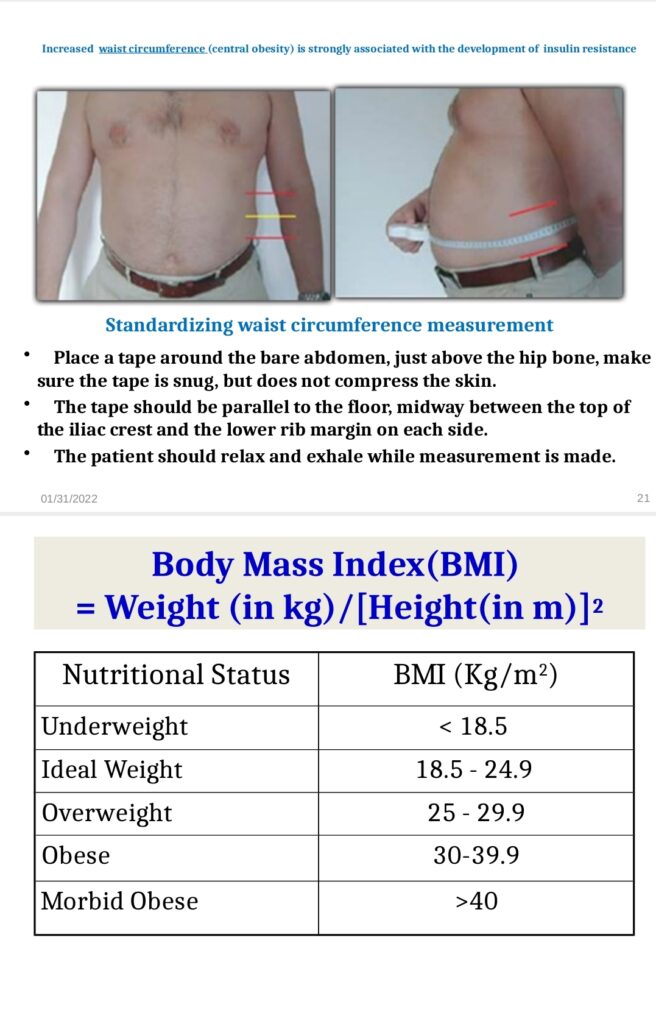
- Height, weight and BMI, waist circumference
- Blood pressure determination, including orthostatic measurements when indicated
- CVS
- Thyroid palpation(Type 1 DM)
- Skin examination for Acanthosis nigricans, infections
- Neurologic exam
- Fundoscopic examination
- Comprehensive foot exam
Waist Circumference
- Normal
– Males – <94 cm
– Females – <80 cm - Measure midway between lower costal margin & iliac crest
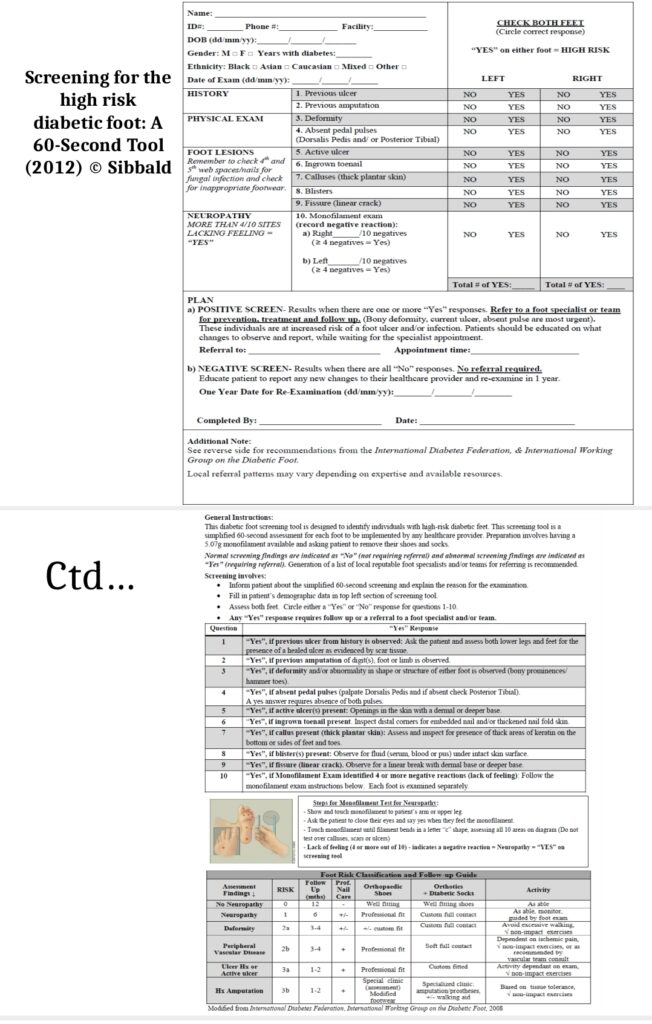
Comprehensive foot examination
– Inspection
– Palpation of dorsalis pedis and posterior tibial pulses
– Presence/ absence of patellar and Achilles reflexes
– Determination of proprioception, vibration and monofilament sensation Use the 60 second screening tool for Diabetes foot screening
Laboratory Evaluation
– For making diagnosis
- FBS
- RBG
- HgA1C
– Other lab evaluations - Liver function tests
- Serum Creatinine
- Fasting lipid profiles
- Urine analysis= Protienuria, ketonuria, glucosuria, infection
- TSH in Type 1 DM, in patients with Dyslipidemia, or women over age 50Yrs
Referral for Initial Care Management
Diabetic patients may need evaluation and care by different health professionals.
- Eye care professional for annual dilated eye exam.
- Family planning for women of reproductive age.
- Preconception care for women
- Dentist for comprehensive dental and periodontal examination.
- Mental health professional, if indicated.
Acute complications of DM
- Diabetic Ketoacidosis (DKA)
- Hyperglycemic Hyperosmolar State ( HHS)
- Hypoglycemia
Case Study 3.
A 28 yrs old Type 1 Diabetic who has been on NPH insulin 22 IU, am and 12 IU, pm, SC. developed cough, chest pain and fever of four days duration. These symptoms were accompanied by polyuria, polydypsia, vomiting and abdominal pain of two days duration.
- On Physical Examination: Patient has deep breathing, is confused,
- B/P, : 80/50mmHg, pulse 124/minute,Temp.38,6oC.,
- Sunken eyes , Bronchial breath sounds in the Left lower posterior lung field.
Questions
What are the Diagnoses of the patient?
How do you confirm the diagnosis?
Case 3. Answers.
- Type 1 DM, DKA, Pneumonia
- FBS/RBS,Urine analysis ,Urine ketone/sugar, CXR
N.B. Patient results were:
- RBS 450 mg/dl,
- Urine sugar :4+,
- Urine ketones 3+,
- CXR: Homogenous opacification in the left lower lung field
DKA & HHS
- very serious DM complications
- if untreated both are life threatening
- both are preventable
- have overlapping features
- both result from relative or absolute insulin deficiency
DIABETIC KETOACIDOSIS
Introduction:
- Diabetic ketoacidosis (DKA) is a condition in which there is severe disturbances in metabolism of carbohydrate(severe hyperglycemia), protein(Catabolism), and fat (lipolysis) that result from insulin deficiency
- This state of severe hyperglycemia and ketone body production results in volume depletion, acid-base and electrolyte abnormalities.
DKA: Introduction cont.
- It often occurs in type 1 diabetes patients but may also occur in type 2 diabetes.
- DKA is a medical emergency requiring urgent treatment as mortality ranges from 10 to 30% in resource limited settings like Ethiopia.
- It is characterized by:
– hyperglycemia (BG>250mg/dl)
– ketosis (urine ketone >/= 2+)
– acidosis
DKA Introduction Cont.
- The precipitating factors of DKA include:
– previously undiagnosed and untreated diabetes,
– Insulin errors, omissions and non-adherence
– stress of Intercurrent illness (e.g., Pneumonia, meningitis, UTIs, Acute Febrile Illnesses, Trauma, myocardial infarction, stroke, surgery, etc)
– Drugs e.g. steroids, cocaine
– Pregnancy
– psychological stress
– no precipitant factors could be found in up to 20-30% of cases
DKA-Clinical features:
- Clinical features may include worsening poly symptoms:
–excessive urination,
– excessive thirst and,
–excessive drinking of water - Non specific symptoms like malaise, fatigue, nausea, vomiting, abdominal pain (may mimic acute abdomen)
- Signs of dehydration with:
–dry skin and
–reduced skin turgor or sunken eyes
–low blood pressure and
–fast and weak pulse.
DKA-Clinical Features…
- Signs and symptoms of acidosis and ketosis,
- deep and fast breathing, and
- ‘Fruity’ breath (smell of acetone).
- Altered level of consciousness (depressed mentation to coma)could be a feature of severe DKA.
- Symptoms of infection or other underlying condition
Laboratory
If you find such clinical features
HC
- Serum/finger prick glucose
- urine analysis – ketones , glucose, leucocytes
- Complete blood count
- pregnancy test in women of child bearing age
- others tests as per the clinical indications
In Primary and General Hospitals
- Serum electrolytes (K, Na),
- renal function, In Tertiary Hospitals
- blood gas analysis ,
- calculation of anion gap and serum osmolality should be done.
Diagnose DKA
- Based on clinical symptoms and signs and
– RBS > 250 mg/dl
– Positive Urine ketone (2+ and above)
– Glucosuria
NB: Some patients can develop DKA even at lower blood glucose levels e.g. Diabetic Pregnant women, partially corrected blood glucose due insufficient dose of insulin.
Management of DKA and HHS
(See Algorithm III)
- Attention to ABC immediately on arrival !!!
- Fluid deficit in HHS is up 10 liters or more
in DKA often 3 to 5 liters Type of fluid to administer:
- start with N/S
- once BG ≤ 250 mg/dl change IV fluid to 5 % dextrose in water(5 % D/W)
Management of DKA/HHS…
- initial fast hydration (1-2 lit. in the 1st hr) then based on response
- follow – hydration status
- UOP & electrolytes
- avoid fluid overload
- Generally replace 50% of total deficit in 8 hrs, the rest in 16 hr
Management of DKA/HHS…
- Insulin
- IV infusion of regular insulin is the standard treatment
– doses: 0.1 Units/kg/hr with initial bolus of 0.1-0.15Units/kg
– let 50 ml fluid through the line before starting infusion - However if insulin pump is not available the following is preferred:
– IV 0.1u/kg stat+
– 0.1 Units/kg IV Q 1hr or subcutaneously every 1-2 hours - Postpone insulin Rx if patient is hypotensive or severely hypokalemic until this is corrected
Management of DKA/HHS…
Goal: blood glucose should decrease by 50-75mg/dl/hr
- If target not achieved increase the hourly insulin dose by 50%
- If blood glucose falls below 250mg/dl shift to 5% D/W
- decrease hourly insulin dose by 50% when blood glucose<200 mg/dl
- Continue infusion till ketone clears
- Keep BG between 150 & 200 mg/dl
- When ketone clears shift to standing NPH Insulin S.C with additional hourly Regular insulin based on Blood glucose for 2 hrs.
Correction of hypokalemia:
- life threatening if uncorrected during DKA Rx
- ensure adequate UOP before K+ administration
- rate of administration depend on serum level of K+
If >5.5 mEq/Lmonitor
If 3.3-5.5mEq/L1 vial ( 20 meq) KCL in every bag of NS
If <3.3 mEq/L2 vials ( 40 meq/l) vials KCL in every bag of fluid and recheck level. Don’t give insulin until potassium >3 .3 meq/L
Case Study 4
- A 67 yrs. old male patient from Adama , Known case of diabetes mellitus for the last 25 yrs. on Glibenclamide of 5mg Bid, presented with history of pain and Ulceration of Rt. foot of one month duration. These symptoms were accompanied by polyuria, polydypsia, generalized weakness and vomiting.
- On Examination patient was comatose, BP: 90/60 mmHg, temp, 36.8oc, ulcerated rt. Foot, with purulent discharge.
- His RBS was > 600 mg/dl.
Question - What are the specific diagnoses of this patient?
- How do you manage this patient?
Case 4. Answers
Diagnosis
- Type 2 diabetes mellitus
- Diabetic Foot infection
- Hyperglycemic Hyperosmolar State (HHS)
Management
– See Algorithm 3 for HHS
– Diabetic foot infection—refer Module 4
Hyperglycemic Hyperosmolar State (HHS)
- It is less common than DKA, but results in more death than DKA because it mainly affects the elderly and those with co – morbidity.
- Occurs in type 2 diabetes mellitus
- it progress is relatively slow
- major features are
– severe hyperglycemia (often>600mg/dl)
– profound dehydration
Management of HHS (See Algorithm no. III)
- Management of HHS is similar to the management of DKA
- but fluid replacement is usually much higher (up to 8- 10 liters)
- Criteria to document improvement
– Hydration status improves
– Mental status clears
– Blood glucose < 200mg/dl
Case Study 5
A 75 yrs. Old , Known case of Type 2 diabetes patient, who has been taking, Glibenclamide 10 mg BID, recently he developed decreased appetite because of lower abdominal pain, he suddenly developed profound weakness, palpitation, sweating and became unconscious.
Questions
What is the most likely diagnosis of this patient?
What will you do for the patient?
How do you confirm the diagnosis?
Case 5 Answers
- Hypoglycemia
- Patient is unconscious so give 50 ml of 40% glucose IV, repeat same dose if no response in 15 min. If still the blood glucose is low start 10% D/W at 100ml/hr. Refer to higher level.
- His Random Blood Glucose was 42 mg/dl
Hypoglycemia
- Hypoglycemia occurs in most patients with type 1 diabetes and some type 2 diabetics.
- Hypoglycemia can cause serious morbidity; if severe and prolonged, it can be fatal.
- Most common risk factors for hypoglycemia are
- fasting or missed meals
- insufficient meals
- overdose of hypoglycemic agents or insulin
- exercise
- chronic kidney disease,
- hepatic disease
- Adrenal insufficiency
- other drugs and alcohol consumption
Clinical Manifestations of Hypoglycemia
- Autonomic manifestations(“You are hungry”)
• Anxiety
• Tremulousness
• palpitations
• sweating
• Hunger, and
• Paresthesias - Neuroglucopenic manifestations (“Your nerves are hungry”)
• headache
• Extreme Fatigue
• Confusion
• Seizure
• drowsiness
• lethargy and coma
Hypoglycemia cont.
- Diagnosis of hypoglycemia in diabetic patient is based on
✓clinical manifestations
✓blood sugar values ≤ 70 mg/dl
✓Rapid response to Glucose Treatment
Management of hypoglycemia (See Algorithm No. IV)
Principles of treatment:
- Hypoglycemia is a medical emergency
- do not wait for confirmation if test is not readily available
- change in mental status in a diabetic is considered to indicate hypoglycemia until proven otherwise !!!
RX of Hypoglycemia
If patient can take by mouth:
- hard candy, glucose tablets or other sources of fast absorbable carbohydrate
N.B.
Forceful attempt to give glucose by mouth in a stuporous or disoriented individual is difficult and may prove harmful – avoid this !!
Hypoglycemia…
More severe hypoglycemia or patient unable to take by mouth:
- Where available administer 0.5 –1mg glucagon IM
- administer 40 or 50% dextrose IV followed by a maintenance dextrose in water infusion
Remember!! - Sufficient amount and durations of Rx
- Rx should be followed by regular feeding
- avoid or treat causes when possible
End Of Unit- 3